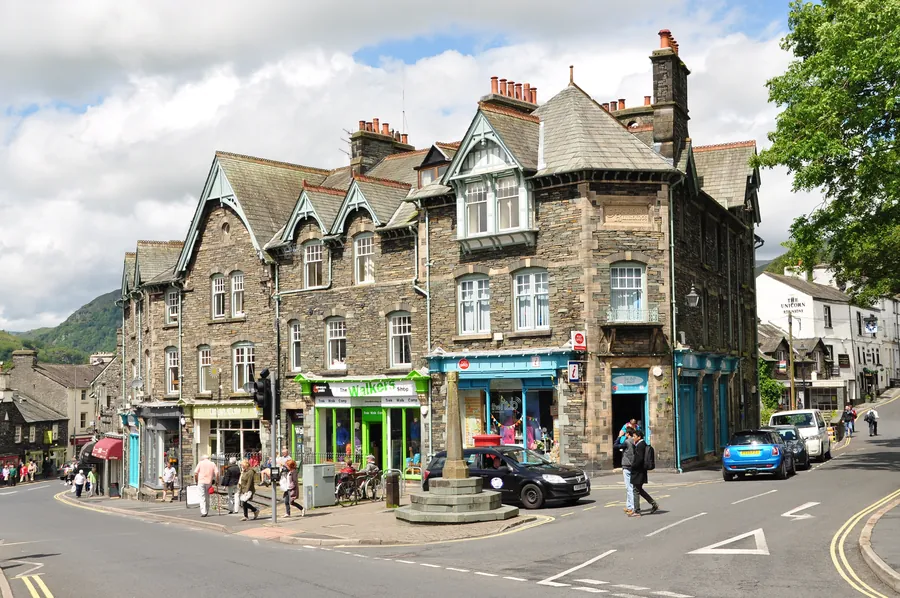
Ambleside is a town at the head of Windermere, England’s largest natural lake, inside the Lake District National Park. The built-up area had an estimated population of 2,586 in 2022, so it is small. It works harder than that suggests: shops selling equipment and guides for walkers and climbers, ten pubs or bars inside a quarter-mile radius, and a mountain rescue team, Langdale & Ambleside, among the busiest volunteer teams in the country.
For anyone staying at Windermere it is the far end of the lake, reachable across the water rather than around it. The straight-line distance from Windermere is 7.0 km; Wikipedia gives no road distance between the two. Ambleside’s pier is not in the town but at Waterhead, about a mile south of the centre.
Almost everything to see sits within a few minutes of the Market Place: a house built on a bridge over the beck, a waterfall up a lane behind the main street, a Roman fort by the shore, and a Victorian church with a wartime mural. The name is older than any of it — Old Norse Á-mel-sǽtr, “river – sandbank – summer pasture”.
Stock Ghyll is the beck that comes down through the middle of the town, and the waterfall on it is the walk most visitors do — 4.7 from 2,802 Google reviews. It is short but uphill: a visitor in June 2026 found “it was a bit steep uphill to reach the water falls”, and added navigation worth having in advance — “Please enter through the revolving door to reach the foot path to waterfalls (you will see a small signpost on the left side of the road).”
The path is rough in places. A visitor in July 2026 warned that you “just need to be careful where to step with all the roots, stones and rocks”. Footwear matters more here than distance does, and a visitor in June 2026 advised, “Make sure you wear a proper footwear not to slip on some muddy areas.”
Rydal Cave, the most reviewed of the places listed for Ambleside at 4.7 from 3,389 Google reviews, is the other walk people name — a cavern reached on foot above Rydal Water. It holds up in poor weather: a visitor in August 2026 wrote, “It’s a good visit even on a rainy day.”
Bridge House was built over Stock Ghyll more than 300 years ago, probably as a summer house and apple store for Ambleside Hall. It has since been a counting house for the mills of Rattle Ghyll, a tea-room, a weaving shop, a cobbler’s, a chair maker’s and, at one point, home to a family of eight. Local people bought it in 1926 and gave it to the National Trust; it is Grade I listed and now serves as a Trust information centre. John Ruskin and JMW Turner both painted it.
It rates 4.5 from 764 Google reviews, and reviewers are clear about its scale: a visitor in July 2026 wrote, “It’s tiny, but super picturesque and definitely worth a quick stop for a photo.”
On the southern edge of the town is Galava, the Roman fort, dating from AD 79. At 4.2 from 916 Google reviews it is the lowest-rated place listed here, and little of it stands. A visitor in May 2026 wrote, “Wasn’t quite what I expected but the walk along the river was great.” Another recorded that the site is free to enter, and that “The path from Borrans Park is well-maintained, though once you are among the ruins, the ground is a little uneven and can get muddy after a typical Cumbrian rain”.
Also listed: Rothay Park at 4.7 from 573 Google reviews, the Stepping Stones at 4.6 from 206, and Stagshaw Gardens at 4.4 from 332.
A charter of 1650 let the town hold a market, and another under James II let it collect tolls; the Market Place became the commercial centre for agriculture and the wool trade. Before the turnpike road was finished in 1770 the main route to Grasmere was the old packhorse trail, and Smithy Brow at the end of it was where pack ponies were re-shod.
When the ancient parish of Kendal was subdivided after the Reformation, the boundary between the new parishes of Grasmere and Windermere followed the stream through the middle of Ambleside, splitting the town. Before the 17th century its dead were buried at St Martin’s Church in Bowness-on-Windermere.
St Anne’s chapel could not hold the congregations once tourism took off with the Kendal and Windermere Railway in 1847, so St Mary’s was built in the 1850s to a design by George Gilbert Scott, with a stone spire unusual among Westmorland churches. Inside is a mural of the rushbearing, a ceremony held on the first Saturday in July, painted during the Second World War when the Royal College of Art was based in Ambleside. The Armitt Library and Museum, opened in 1912, covers Lake District artists and writers.
Ambleside is a base for hiking, mountaineering and mountain biking, and a common starting point for the Fairfield horseshoe ridge walk. The University of Cumbria campus at the northern end teaches Conservation, Forestry and Outdoor Studies. Two Michelin-starred restaurants are here, Lake Road Kitchen and The Old Stamp House.
The climate is oceanic and the rainfall higher than the average for the North West of England. Parts of the town have flooded on numerous occasions, the River Rothay breaking its banks during Storm Desmond in December 2015.
The boat is the distinctive way in. Ambleside Pier at Waterhead is a boarding point for Windermere Lake Cruises, running year-round to Bowness-on-Windermere and Lakeside; between March and October a second service runs to the Brockhole visitor centre and Wray Castle. The vessels are diesel, though “steamers” survives as the name. Waterhead has hotels, cafés, boat hire and a YHA hostel, and is buffered from the town by green space — allow for the mile in.
By bus, services from Ambleside are run predominantly by Stagecoach Cumbria. At the Windermere end, the station forecourt has frequent buses into town and on to Bowness-on-Windermere and Ambleside, plus a taxi rank.
There is no station at Ambleside. The nearest National Rail station is Windermere itself, at the end of the branch line from Oxenholme on the West Coast Main Line.
The village and what is around it, at walking scale.
Open any of them in Google Maps for directions and current opening.
Attractions, prices and availability in Windermere
These come from GetYourGuide's booking widget, which sets their cookies in your browser. Consent to load it and see the attractions and prices.
Background on Ambleside draws on its Wikipedia article, text there being available under CC BY-SA 4.0.