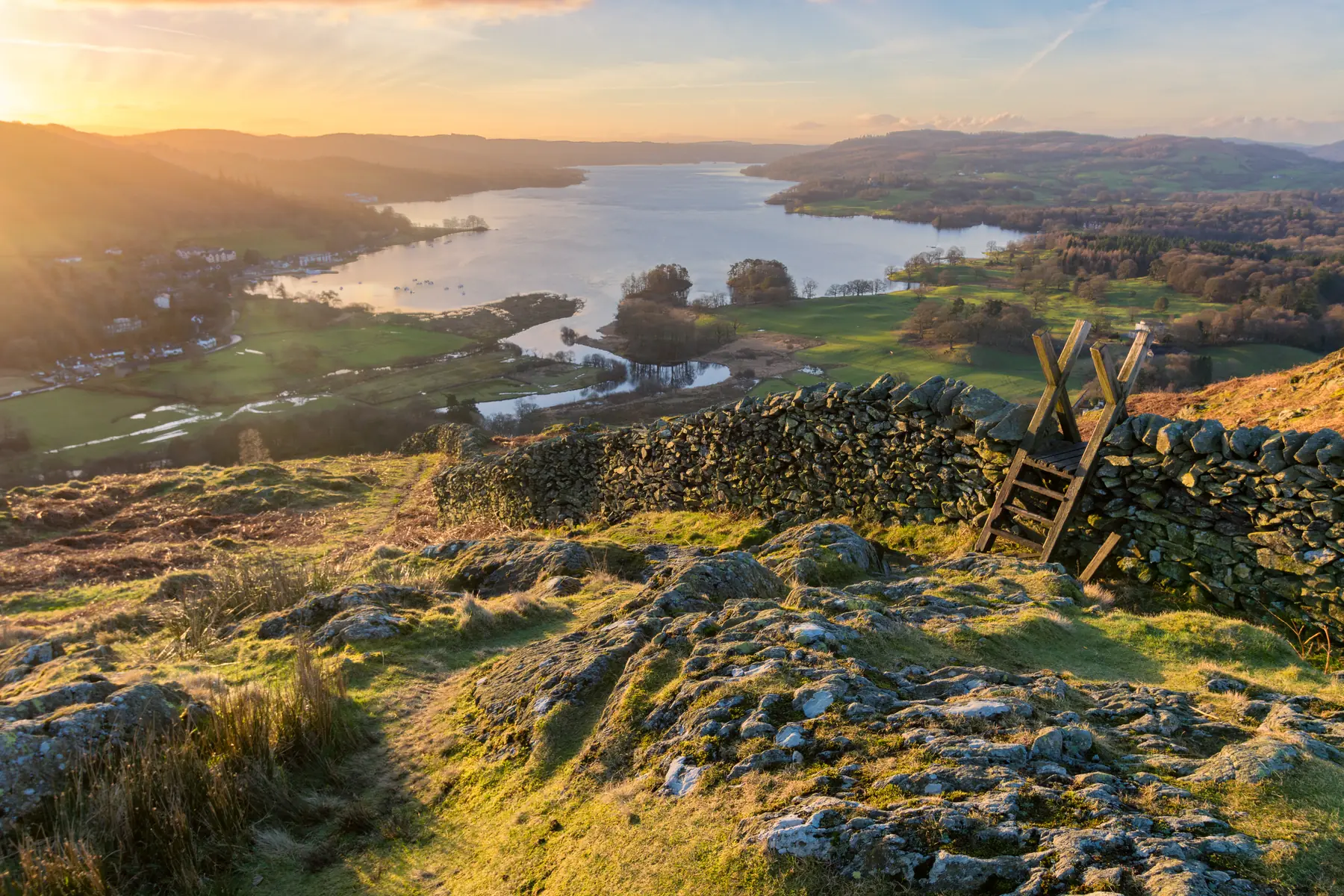
Windermere sits at the south-eastern corner of the Lake District with the whole national park to the north and west, and it is the best-connected place in it — the branch line from Oxenholme puts it on the national rail network, and the A591 runs from here through Ambleside and Grasmere to Keswick.
Everything below is within an hour, and most of it within half.
Two warnings. Lake District roads are narrow, walled and slow, and they queue badly in season. And the honeypot car parks — Tarn Hows, Grasmere, Pen-y-Ghent of the south — fill by mid-morning from Easter onwards.
Seven kilometres north at the head of the lake. A slate-built town with more outdoor shops than seems plausible, the Bridge House — a tiny two-room building straddling a beck — the remains of a Roman fort at Waterhead, and Stock Ghyll Force, a twenty-metre waterfall fifteen minutes’ walk from the centre.
The lake cruises land at Waterhead, which makes Ambleside the natural half-day trip by boat.
Twelve and sixteen kilometres north. Wordsworth country: Dove Cottage at Grasmere where he wrote his best work, Rydal Mount where he lived comfortably later, his grave in Grasmere churchyard, and the gingerbread shop beside it.
The walking here is the best in the southern Lakes: the Coffin Route between Rydal and Grasmere, Loughrigg Terrace with the classic view down the lake, and Rydal Cave, a vast quarried cavern you walk into.
Five kilometres west across the ferry. A village of whitewashed cottages and cobbled squares with no cars in the centre, the grammar school Wordsworth attended, the Beatrix Potter Gallery holding her original artwork, and Hill Top at Near Sawrey nearby.
Above Hawkshead: a tarn ringed by conifers with a level surfaced path all the way round, entirely man-made in the nineteenth century, and among the most photographed places in England.
Ten kilometres west. A village under the Old Man of Coniston with Coniston Water below it, the Ruskin Museum — covering John Ruskin, who lived at Brantwood across the water, and Donald Campbell, who died on the lake in 1967 attempting the water speed record — and the Steam Yacht Gondola, a National Trust steam launch of 1859 restored and running.
Grizedale Forest between Hawkshead and Coniston has walking, mountain biking and sculpture trails.
Keswick is fifty kilometres north on the A591, about an hour, at the head of Derwentwater — a different, wilder Lake District, with Skiddaw and Borrowdale behind it and a launch service round the lake.
Thirlmere and Helvellyn are on the way, and Castlerigg Stone Circle is on the edge of Keswick.
It is a long day but a straightforward one, and the 555 bus does it if you would rather not drive the A591 in August.
Forty kilometres, about an hour via Kirkstone Pass — the highest road pass in the Lake District, and a spectacular drive in itself.
Ullswater is the second largest lake and, to many people, the most beautiful: Aira Force waterfall on its shore, the Ullswater Steamers, and Helvellyn rising behind Glenridding.
The walk along the eastern shore from Howtown back to Glenridding, taking the steamer out and walking back, is regularly called the finest lakeside walk in England.
Kendal, thirteen kilometres east, is a proper town outside the national park — museums, an arts centre, a castle, a covered market and shops. The wet-day standby.
Sizergh and Levens Hall nearby are both substantial houses with famous gardens; Levens has the oldest topiary garden in the world.
Cartmel, thirty kilometres south, is a village with a priory, a racecourse, a sticky toffee pudding industry and a restaurant scene well beyond its size.
Furness and the coast — Furness Abbey, the Lakeland Motor Museum and the sands of Morecambe Bay — are beyond that.
Lakeside, at the southern end of Windermere, has the aquarium and the Lakeside and Haverthwaite steam railway, both reachable by boat.
Better than most of the Lake District. Windermere station is the end of a branch from Oxenholme on the West Coast main line, with trains roughly hourly and connections to London, Manchester, Glasgow and Edinburgh.
The 555 bus runs the length of the A591 from Kendal through Windermere, Ambleside and Grasmere to Keswick — one of the great British bus routes, and it does most of this page. The 599 open-top runs Bowness to Grasmere in season.
And the lake cruises are transport: Bowness to Ambleside, Bowness to Lakeside for the aquarium and the steam railway, and the chain ferry to the west shore for Hawkshead and Hill Top.
Between them, a car-free week here is entirely practical. Our getting here page has more.
The Wordsworth day, by bus. The 555 north to Rydal for Rydal Mount, walk the Coffin Route to Grasmere for Dove Cottage and the churchyard, add Loughrigg Terrace if the legs allow, and take the bus back. No driving, no parking, and the best of the central Lakes.
The ferry day. Chain ferry to Far Sawrey, Hill Top at Near Sawrey with a booked ticket, on to Hawkshead for the village and the gallery, then Tarn Hows in the afternoon. Back on the ferry.
The Coniston day. West by road to Coniston for the Ruskin Museum and the Steam Yacht Gondola, across the water to Brantwood, and back via Grizedale Forest and Hawkshead. A lake, a Victorian steam launch and a sculpture forest.
The A591 is the spine and it queues badly from Easter to October, particularly around Ambleside and Grasmere. The lanes west of the lake are single-track with passing places, and the honeypot car parks — Tarn Hows, Grasmere, Stock Ghyll, Pen-y-Pass further north — fill by mid-morning.
Three habits fix most of it: start early, use the 555 bus along the A591, and use the boats and the chain ferry, which go where the roads queue.
Ambleside and Grasmere for Wordsworth and the walking; Coniston and Hawkshead across the ferry; Keswick if you want a full day and a wilder landscape.
Fifty kilometres north on the A591, about an hour, and the 555 bus does it.
Yes, about an hour via Kirkstone Pass, which is the highest road pass in the Lakes and worth the drive on its own.
The chain ferry from Bowness to Far Sawrey, then a short drive or a walk. It is much quicker than going round by road.
Yes — Wordsworth’s grave, Dove Cottage, the gingerbread shop and some of the best walking in the Lakes. It is also extremely busy; go early.