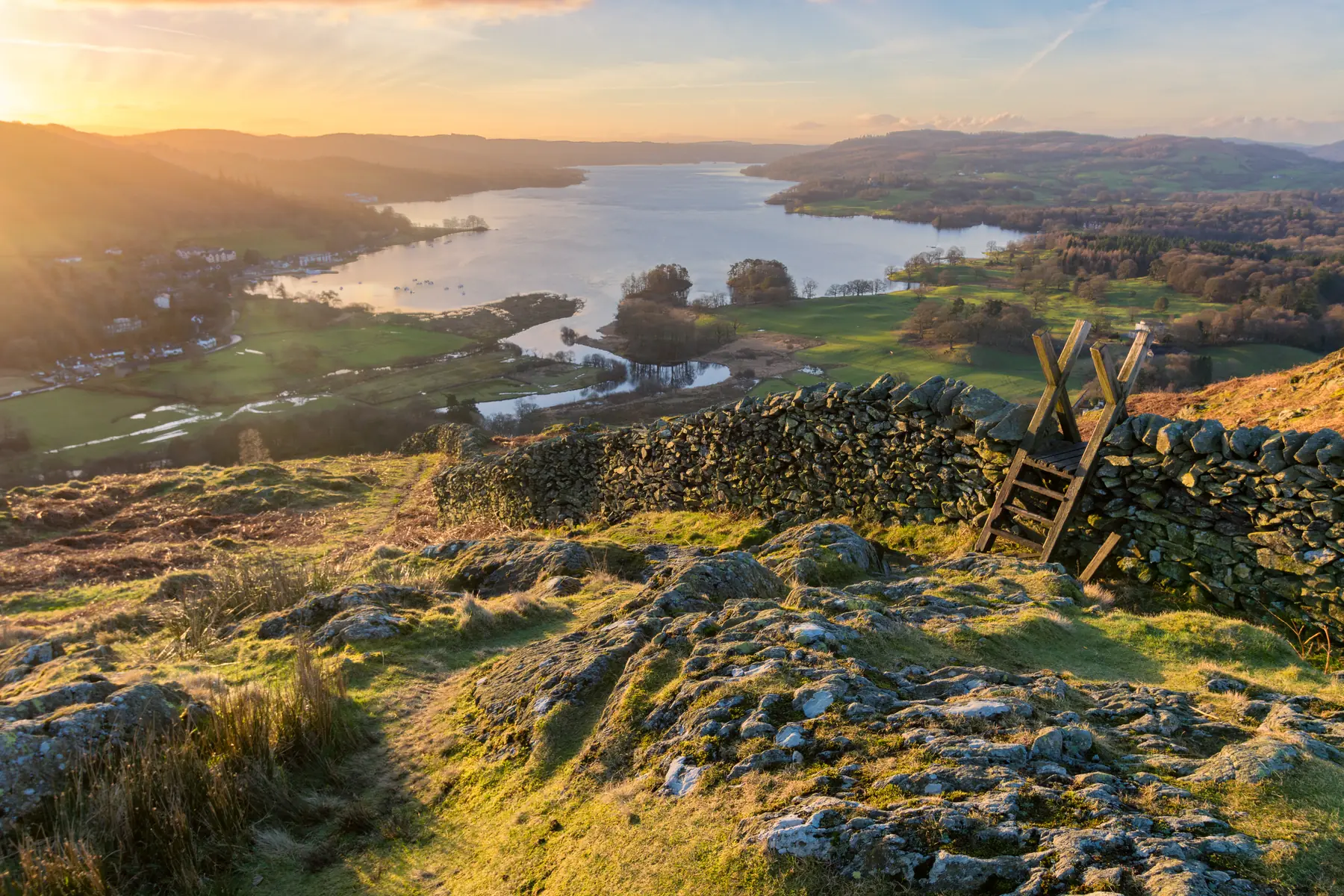
Beatrix Potter is why a great many people come to this part of the Lake District, and the story is a good deal more interesting than the picture books suggest. She was a serious naturalist and mycologist before she was an author, she became a successful commercial farmer and one of the country’s leading breeders of Herdwick sheep, and when she died in 1943 she left over four thousand acres and fifteen farms to the National Trust.
A substantial part of the landscape you look at around Windermere is protected because of her.
Near Sawrey, across the ferry from Bowness — the seventeenth-century farmhouse she bought in 1905 with the proceeds of The Tale of Peter Rabbit, and where she wrote and illustrated many of the later tales.
She left it to the National Trust on the condition that it be kept exactly as she had it, and it has been: her furniture, her china, her pictures, and the rooms that appear in the illustrations of The Tale of Samuel Whiskers and The Tale of Tom Kitten. Walking into it and recognising a room from a book you were read at four is a strange and rather affecting experience.
Practicalities matter here. It is a very small house and visitor numbers are strictly limited. Entry is by timed ticket, they sell out, and in season you should book ahead or arrive early. The garden is as she planted it and the village of Near Sawrey around it has barely changed.
Hawkshead, five kilometres from the ferry. Her husband William Heelis was a country solicitor and this was his office; the National Trust now uses it to display a rotating selection of her original artwork — the watercolours and drawings for the books, plus her natural history studies.
The natural history work is the surprise. Her fungi paintings are scientifically serious, and her paper on the germination of spores was presented to the Linnean Society in 1897, at a time when a woman could not present it herself.
The building is small, timber-framed and largely unaltered.
In Bowness, and a different proposition entirely: a commercial attraction recreating the tales in three dimensions, with Peter Rabbit’s garden, Mr McGregor’s greenhouse, a tearoom and an indoor garden.
It is aimed squarely at under-eights and it does that job well. It is not a literary or biographical experience and does not pretend to be. If you have small children it is a good hour; if you want Beatrix Potter herself, Hill Top and the gallery are where to go.
On the western shore, National Trust. A Victorian mock-Gothic pile built in 1840, where the sixteen-year-old Beatrix Potter holidayed with her family in 1882 — her first visit to the Lake District, and the trip on which she met Canon Hardwicke Rawnsley, the vicar of Wray, who became a friend and mentor.
Rawnsley went on to be one of the three founders of the National Trust, and it was largely his influence that turned Potter into a conservationist. That holiday, in other words, produced both the books and the land.
The castle is largely unfurnished and given over to family activities, which makes it a relaxed visit, and the grounds run down to the lake.
The part most visitors miss. From 1923 Potter bought Troutbeck Park Farm and then a string of others, and she farmed them seriously — she bred Herdwick sheep, the hardy fell breed, showed them successfully, and was elected president of the Herdwick Sheepbreeders’ Association shortly before her death.
Her bequest to the National Trust of over four thousand acres and fifteen working farms was made on condition that the Herdwick flocks be maintained on the fells. They still are, and the Lake District’s designation as a World Heritage Site in 2017 rests substantially on that farming landscape.
So the fells above Troutbeck and around Coniston, the walls, the flocks and the farms are the largest part of her legacy — and they are free to walk in.
Take the chain ferry from Bowness to Far Sawrey in the morning. Walk or take the bus to Near Sawrey for Hill Top, with a timed ticket booked in advance. Lunch in the village. Continue to Hawkshead for the Beatrix Potter Gallery and the village itself.
Come back over Claife Heights on foot with the lake below you, or take the bus and the ferry.
Add Wray Castle on the west shore if you have a full day, and Tarn Hows — which she bought and gave to the Trust — if you have longer.
Book Hill Top. It is the single most-booked property the National Trust owns for its size, and turning up without a ticket in August means a long wait or none at all.
Getting there. Chain ferry from Bowness, then bus or a two-kilometre walk to Near Sawrey. By road it is the best part of an hour round the lake.
National Trust members go free to Hill Top, the gallery, Wray Castle and Tarn Hows, which makes a membership pay for itself in a day here.
Near Sawrey and Hawkshead are both very small and parking is limited. The ferry and bus are the sensible approach.
Season. Hill Top and the gallery close in winter; check before travelling.
A practical note for anyone planning a Potter trip. The three sites are very different in character and doing all three in one day is a mistake.
Hill Top is small, crowded and timed, and it rewards being unhurried — half an hour inside, plus the garden and the village. The Beatrix Potter Gallery at Hawkshead is a quiet forty minutes and is where the actual artwork is. The World of Beatrix Potter in Bowness is an hour of indoor entertainment for small children and is on the other side of the lake.
The sensible split is Hill Top and the gallery together on one day, across the ferry, and the Bowness attraction on another — probably a wet one.
If you have longer, add Wray Castle on the west shore for the family connection, and a walk on the fells above Troutbeck, where the farms she left the National Trust are still working.
At Hill Top, Near Sawrey, from 1905, and later at Castle Cottage in the same village after her marriage. Hill Top is preserved as she left it.
Yes, in season. Entry is by timed ticket, numbers are strictly limited and it sells out.
Hill Top is her actual house, preserved. The World of Beatrix Potter in Bowness is a commercial attraction recreating the tales for young children.
Yes, and a serious one — she bred Herdwick sheep, won prizes with them and was elected president of the Herdwick Sheepbreeders’ Association.
Over four thousand acres and fifteen farms, on condition that the Herdwick flocks were kept on the fells. They still are.