Wray Castle stands above the western shore of Windermere, five kilometres from the town, and it is not a castle. It is a large Victorian house built in 1840 in mock-Gothic style — battlements, turrets, a great hall — for a retired Liverpool surgeon named James Dawson, paid for with his wife’s inherited gin fortune. The story locally is that she disliked it and refused to live there.
The National Trust owns it now, and what makes it unusual among historic houses is that it is largely empty.
Most of the original contents are long gone, and rather than filling the rooms with substitutes the Trust has leaned into it. The interiors are used for family activities, dressing-up, play spaces, imaginative installations and changing exhibitions, with the architecture — the vaulted hall, the staircase, the enormous windows — left to speak for itself.
The practical result is a historic house where children can run about and nobody minds, which is a rare thing. Families consistently rate it more highly than the architecture alone would justify, and adults who arrive expecting a furnished country house sometimes leave puzzled. It is worth knowing which you are getting.
The house has one genuinely significant connection. In 1882 the Potter family took Wray Castle for a summer holiday, and the sixteen-year-old Beatrix Potter saw the Lake District for the first time.
During that holiday the family met Canon Hardwicke Rawnsley, then vicar of the nearby church at Wray, who became a friend and a formative influence. Rawnsley was one of the three founders of the National Trust, and it was largely his conservation politics that turned Potter from a visitor into someone who would eventually buy fifteen farms and leave them to the nation.
So the summer that produced the books also produced the land. There is a small exhibition on this in the house.
Arguably the better half. The estate runs down to the lake shore with wide lawns, mature specimen trees — including some very large sequoias planted in the 1840s — and woodland paths. There is direct access to the west shore of Windermere, which is the quiet side, and the views across the water to the eastern fells are excellent.
The grounds link into the Claife Heights paths and the shoreline walks north towards Ambleside and south towards the ferry, so the castle works well as the start or finish of a walk.
St Margaret’s Church at Low Wray, built by the same owner, is a short walk away.
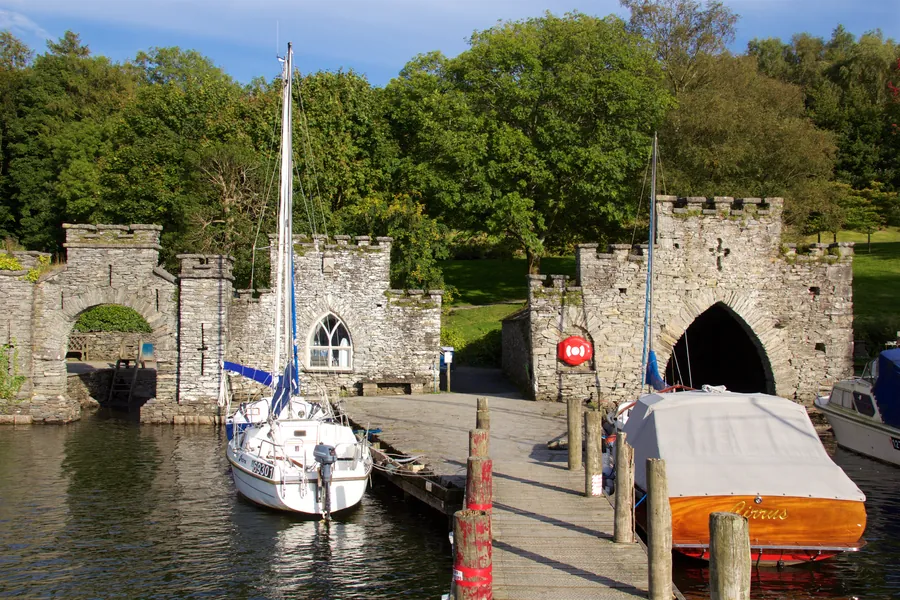
By boat. The most enjoyable route: Windermere Lake Cruises run to Wray Castle’s own jetty from Bowness and Ambleside in season, landing you at the bottom of the lawn.
By ferry and road. The chain ferry from Bowness to Far Sawrey, then a slow lane north along the west shore.
By road from Ambleside. About seven kilometres round the head of the lake through Clappersgate and Low Wray. The lane is narrow.
Parking is limited and the approach is a single-track road. In season the boat is much the better idea.
National Trust property — members go free, others pay for the house; the grounds have their own arrangement, so check on arrival.
There is a café and a shop.
The ground floor and the grounds are largely accessible; the upper floors involve stairs.
Opening is seasonal, with the house closed over the winter and the grounds more widely open. Check before travelling.
No. It is a Victorian house of 1840 built in mock-Gothic style, complete with battlements, for a retired Liverpool surgeon.
Largely not. The Trust uses the empty rooms for family activities and exhibitions rather than recreating interiors, which makes it unusually relaxed with children.
Her family holidayed here in 1882, when she was sixteen and seeing the Lake District for the first time. They met Canon Rawnsley, a founder of the National Trust, who became her mentor.
By Windermere Lake Cruises to the castle’s own jetty in season, or by road round the west shore. The lanes are narrow and parking is limited.
For the grounds, the lake shore and the story, yes. For furnished period interiors, no — there are none.