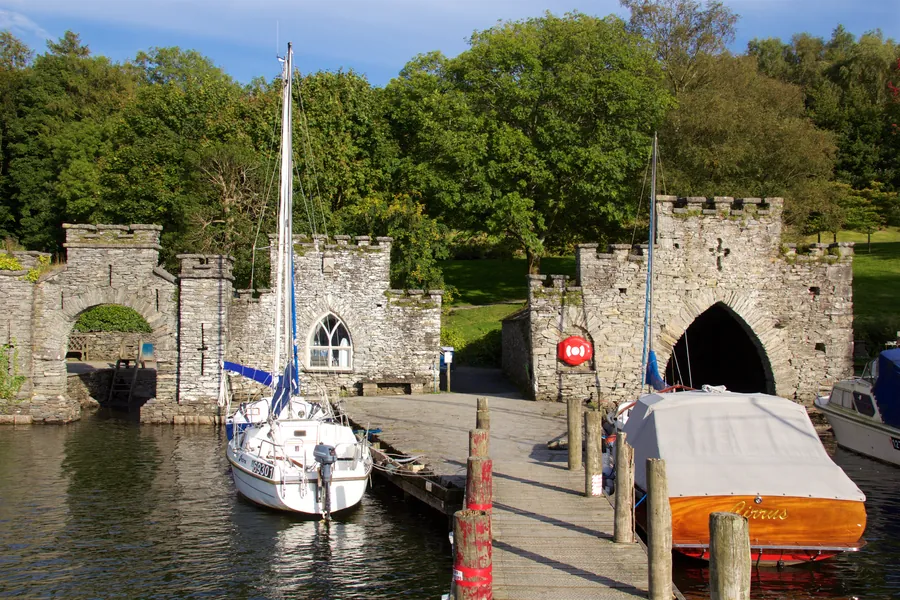
Fell Foot sits at the very bottom of Windermere, nine kilometres south of the town near Newby Bridge, and it is the most straightforwardly enjoyable place on the lake. Eighteen acres of Victorian pleasure grounds running down to the water: mown lawns, mature trees, a shingle beach, a boathouse, a café and a great deal of space to sit.
There is no house — the mansion was demolished in the 1900s — and no collection. It is a park with a lake at the end of it, which is exactly what most people want.
Swimming. Fell Foot is one of the best places on Windermere to get into the water: the shore shelves gently, there is a marked area, and open-water swimming here has become popular enough that it is part of the park’s identity. The water is cold year-round — genuinely cold, not bracing — and warmest in late August and September.
Boats. Rowing boats, kayaks, canoes and paddleboards are hired from the boathouse in season, and the southern end of the lake is calmer and less busy than the middle.
Sitting about. The lawns run to the water’s edge with views north up the length of the lake to the fells. It is the best picnic ground on Windermere and it is what most visitors actually do here.
Walking. Paths run through the grounds and along the shore, and it is level throughout.
Fell Foot was laid out in the 1860s as the grounds of a country house, and the layout survives even though the house does not. The boathouses on the shore are Victorian Gothic and are the most photographed thing here; the specimen trees, the terraces and the shape of the lawns are all from the same period.
The National Trust took it on in 1948, and in recent years has reworked the grounds — restoring the meadows, replanting and rebuilding the visitor facilities — with an emphasis on making the shoreline usable rather than ornamental.
By car: it is signposted from the A592 near Newby Bridge, at the southern end of the lake. There is a large car park, which is charged and free to National Trust members, and it fills on hot summer weekends.
By boat: Windermere Lake Cruises call at Lakeside, immediately across the water, and there is a seasonal launch link. Arriving by boat from Bowness is much the nicest approach.
By train: the Lakeside and Haverthwaite Railway terminates at Lakeside, a short distance away, and connects with the cruises.
By bus: services along the A592 to Newby Bridge.
Lakeside, across the water, has the Lakes Aquarium and the steam railway. Newby Bridge has pubs. Cartmel, with its priory and its food, is fifteen minutes south. Grizedale Forest is a short drive west.
Combining Fell Foot with a cruise up the lake and the aquarium makes a full and easy day.
There is a café and toilets, and the facilities have been rebuilt in recent years.
The grounds are largely level and accessible, with paths to the shore.
Dogs are welcome on leads in most of the park.
The park is open year-round; the boat hire and some facilities are seasonal.
Swimming is at your own risk. The lake is cold, it is deep away from the shelf, and there are no lifeguards.
Entry to the park is free; the car park is charged, and National Trust members park free.
Yes — it is one of the most popular open-water swimming spots on Windermere, with a gently shelving shore. There are no lifeguards and the water is cold year-round.
Yes, in season — rowing boats, kayaks, canoes and paddleboards from the boathouse.
No. The mansion was demolished in the early twentieth century; what survives is the Victorian park, the boathouses and the shoreline.
By road round the eastern shore in about twenty minutes, or by lake cruise to Lakeside and across, which is the better way.